Working for clients
Freelancers, consultants, the self-employed: you sell your time. Usually that takes a time tracker, a spreadsheet of hours, an invoicing service, and your mail open beside them, with your memory holding it all together.
In Sioul it is one loop, in one window. The client's mail comes to their project. The work is counted while you do it. The invoice is made from what was counted, and waits in your budget until it is paid.
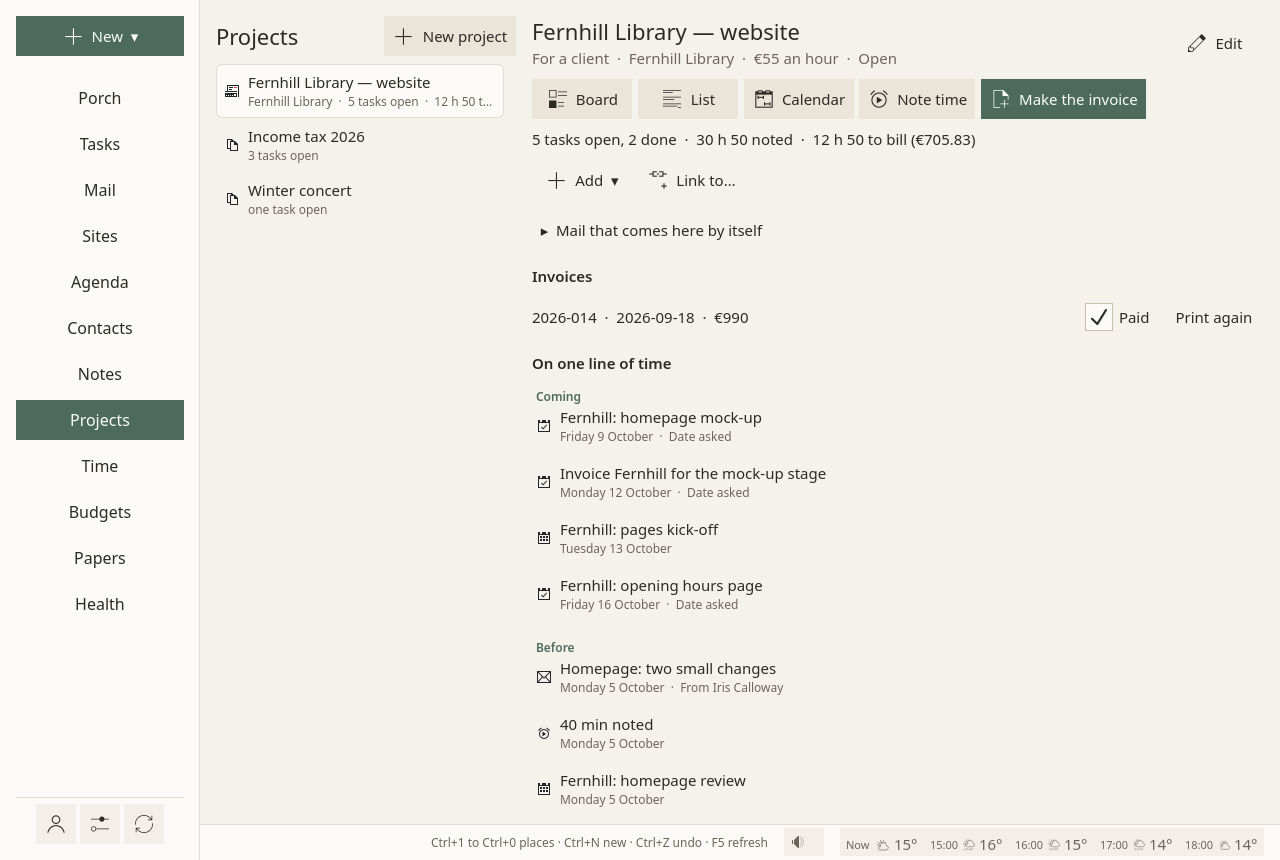
The loop, from the first mail to the paid invoice
- A project per client. New ▾ ▸ A project, then For a client: its time is billed at an hourly rate: who it is for, what an hour costs, and the budget where its money is expected. When For names one of your contacts (their name, or their organisation), the invoice takes the contact's postal address. Link to…, at the end of the project, ties the client's contact to it, with whatever else belongs there: a note, an event, a site. Projects
- Their mail comes by itself. Give the project the client's domain or addresses, words of a subject, or of an attachment's name ("quote"): the messages that match are filed with it, each with the reason it came. Replies follow their conversation. Mail that comes here by itself
- The work fits in your working hours. The project's tasks, as a board, a list or a calendar; the one next step, placed in the hours you keep for work. Tasks
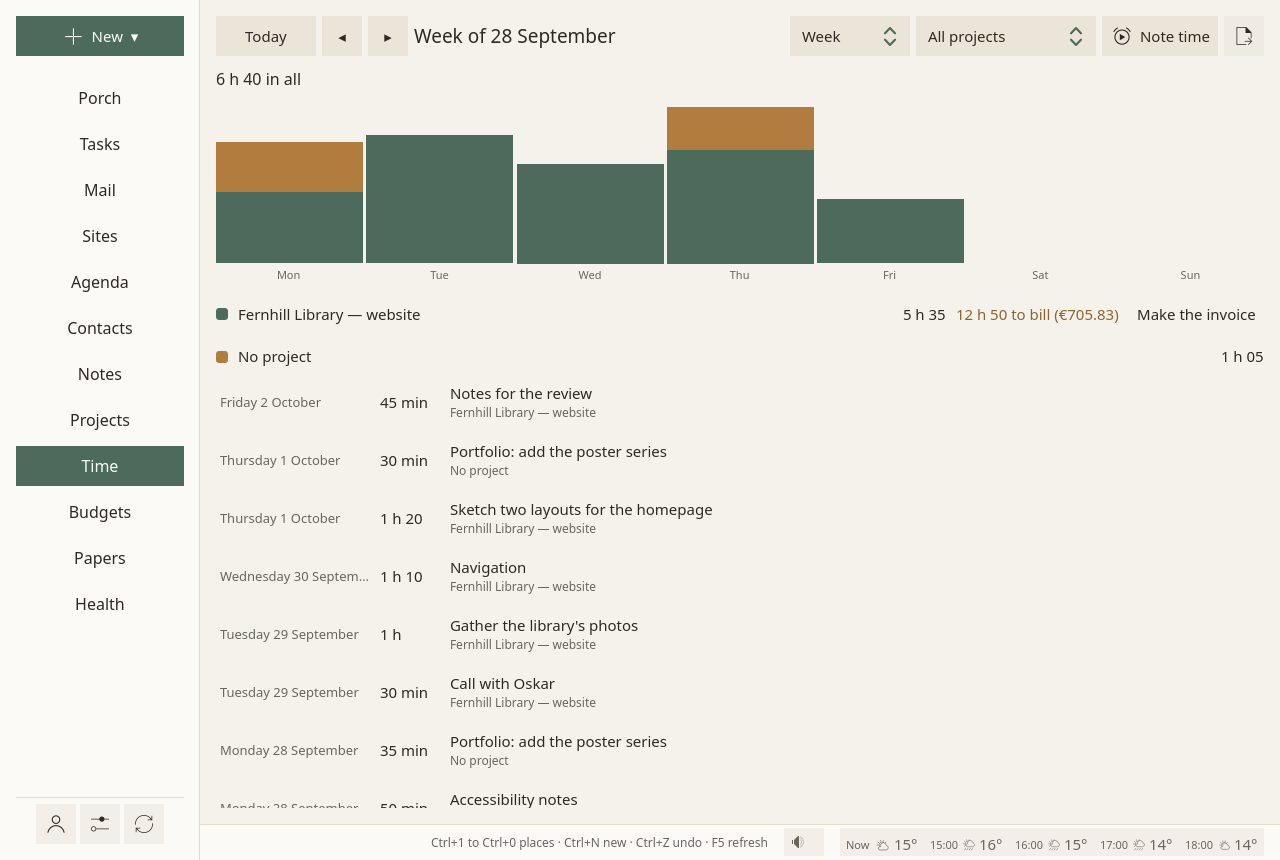
- Time counts while you work. The minutes of a focus session go to its task, and to the task's project. A meeting, a call, work done away from the timer: Note time,
1h30. A task can be left off the bill. Where time comes from - What is left to bill stays in view: for each project, in hours and in money, on the Time page and beside the project. The Time page
- The invoice, from that time. Make the invoice: one line per task, at the project's rate; a number that follows the last one and is never given twice; the time it bills marked as billed, so that the next invoice leaves it out; a PDF, ready to send. Invoices
- Until it is paid. The total is expected in the project's budget, due thirty days later. Paid puts the money in. Budgets
Set once
Settings ▸ Invoices: your name or business name, your address, your SIRET or your business number, the VAT line, how invoice numbers start, your currency, your payment details, your hourly rate. Every invoice then carries them. Settings ▸ Invoices
For a French micro-entrepreneur, the invoice carries what the law asks for: the SIRET, « TVA non applicable, art. 293 B du CGI », the late-payment penalties and the €40 recovery fee. Elsewhere, the VAT line and the payment details are yours to word.
For your accountant
Billable time, as a spreadsheet (CSV): one project, a stretch of time (this month, last month, from one day to another), one line per task with its hours, its rate and its amount, then the total. A spreadsheet of billable time
On your desktop and your laptop
Time noted on one computer is on the others a minute later, and so are the invoices: sealed end to end, through a folder your sync already carries (Nextcloud, Dropbox, Syncthing). There is no server of ours in between. Projects travel with your notes folder; tasks and events through your calendar's server. One computer numbers the invoices, so that a number is never given twice. Sharing between your computers
Phones: an Android version is being tried. It is not ready, and does not share with your computers yet.
And then it rests
Outside your working hours, client projects and the Time page rest: "Work projects rest until work comes back." Being paid by the hour is no reason to work every evening. Hours
Not there yet
Invoices are for hourly work, without VAT added to their totals. Quotes, fixed-price lines, expenses and VAT amounts are not made yet.
Yours
Your time, your clients and your invoices stay on your computer, in plain files: no account to open, no subscription, no server of ours. Sioul is free software (GPL-3.0-or-later). Privacy and security